
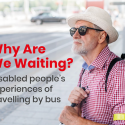
Bus Users UK, the leading charity campaigning for passengers’ rights, has published a revealing new study:
Why are we waiting? Disabled people’s experiences of travelling by bus
Through first-hand, personal accounts, the report captures the lived-experiences of disabled bus passengers across England, Scotland and Wales.
The findings highlight a stark reality: while buses are essential for enabling people to lead full and independent lives, currently they are not accessible to everyone.
Key findings:
Infrastructure: Many bus stops lack essential facilities such as seating or shelter, making it exhausting and painful for some disabled participants to wait for a bus. Obstacles such as heightened kerbs, bins, and bike stands pose difficulties and dangers in accessing and boarding buses.
Bus design: Wheelchair spaces often face away from information displays and there can be competition between passengers for space.
Information: Inconsistent and outdated timetables, contradictory information on apps and at bus stops, and poor and inaccessible or missing audio and visual information on buses have left passengers stranded or forced them to abandon their journeys.
Bus drivers: The behaviour and attitude of bus drivers significantly impacts the journey, and in some cases even the ability, of a disabled person to travel.
Passengers: The behaviour and attitude of other passengers can also make or break a journey.
Claire Walters, Chief Executive of Bus Users UK said: “At some point in our lives, we are all likely to need more accessible transport and buses can provide that, offering independence and enabling people to lead active and fulfilling lives. However, despite many recent advances in legislation, staff training and vehicle design, buses are still far from fully accessible and this research highlights, in their own words, the many challenges facing disabled passengers.
Bus Users UK has made a raft of recommendations in the report, emphasising the urgent need for collaboration between Government, transport industry stakeholders, local authorities and disabled people.
Claire Walters continued: “Why are we waiting? makes a vital contribution towards understanding barriers to travel and demonstrates the importance of working with disabled passengers to overcome them. What we need now is a sustained commitment, collaboration, and funding to ensure that bus travel offers a genuinely reliable, accessible and environmentally friendly option for everyone.”
The study was funded by the Motability Foundation through one of their user research grants.
Chelsea Fleming, Innovation Manager at the Motability Foundation said: “This is an eye-opening piece of research from Bus Users UK, highlighting the lived-experience of disabled people when travelling by bus. At the Motability Foundation we want to help break the barriers that disabled people face when using public transport, and we hope that the recommendations made in this report help to bring about improvements to the accessibility of bus travel.”
Why are we waiting? 2024 LARGE PRINT
About the report
Funded by the Motability Foundation, the research was conducted with social research agency Revealing Reality and microeconomics consultancy, Frontier Economics.
Thirty-two people of different ages and backgrounds, with visible and/or non-visible disabilities were invited to document their bus journeys in a two-week diary. They shared images, videos, and reflections of their experiences. Revealing Reality then shadowed some of the travellers, undertaking a short in-person interview, while conducting longer, remote interviews with others.
Frontier Economics supported the qualitative research with existing quantitative data
About Bus Users UK
Bus Users UK champions the rights of passengers and campaigns for inclusive, accessible transport. Their work with local communities, transport bodies and government at all levels is helping to improve services for everyone.
As the only approved Alternative Dispute Resolution Body for the bus and coach industry, they handle complaints under the Passenger Rights in Bus and Coach Legislation and are part of the Sustainable Transport Alliance, a group dedicated to promoting the benefits of public, shared and active travel.
About the Motability Foundation
The Motability Foundation is a national charity set up with all party parliamentary support in 1977 and incorporated by Royal Charter. It funds, supports, researches and innovates so that all disabled people can make the journeys they choose. It oversees the Mobility Scheme and provide grants to help people use it, providing access to transport to hundreds of thousands of people a year.
The Motability Foundation awards grants to other charities and organisations who provide different types of transport, or work towards making transport accessible. It also carries out ongoing research, in partnership with disabled people and key stakeholders in the industry, to inspire innovations that continue to champion accessible transport for all.
About Revealing Reality
Revealing Reality is an independent social research agency, working with regulators, government and charities to provide insights that inform decision making, policy recommendations, and service design. They conduct detailed qualitative and quantitative research into services and their users – observing how systems function and capturing a range of different perspectives to understand user experience and unmet need.
About Frontier Economics
Frontier Economics is one of the largest economic consultancies in Europe, providing economics advice to public and private sector clients on competition policy, public policy, regulation, commercial strategy, behavioural economics and energy and climate change.